





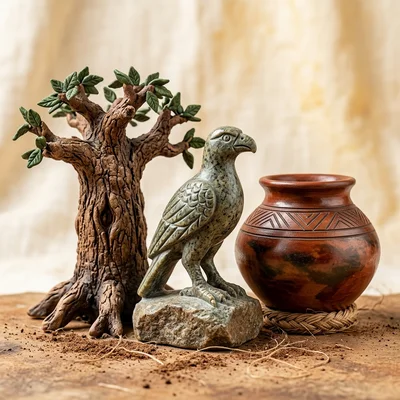
Utsanzi neMhizha · Traditional Shona Arts, Crafts & Artisanship
Traditional Arts & Crafts (Mhizha neMabasa eMaoko)
Celebrate the master craftsmanship of the Shona people: world-famous serpentine stone sculpture (Kuveza Dombo), burnished clay pottery (Kuumba Hari), woven ilala baskets (Tswanda), forged ironwork (Kupfura Simbi), and baobab fibre weaving (Nhava neGudza)!
🏺 8 Traditional Crafts & Arts
🗿 Stone & Hardwood Carving
🧺 Pottery, Forging & Weaving
🔊 Spoken Audio on Tap

Kuveza Dombo (Chivezwa cheDombo)
Shona Stone Sculpture

🗣️ koo-VEH-zah DOH-mboh / chee-VEH-zwah
🪨 Zvishandiso (Materials & Tools): Serpentine, Springstone, Opal Stone & Soapstone (Munyati)
Kuveza mifananidzo pamatombo akaita seserpentine nemunyati idzidziso yakadzama muZimbabwe. Muvezi anoshandisa mbezo, nyundo, nemvura kukwenenzvera dombo kusvikira rabwinya.
World-famous Zimbabwean stone sculpture, rooted in the sacred soapstoneHungwe birds of Great Zimbabwe. Sculptors hand-chisel serpentine and springstone, rasping, sanding, and heating the stone with beeswax until it gleams like polished obsidian or emerald.
🌟 Utsanzi neTsika (Artisanal Note):
Many Shona sculptors describe their art not as inventing a shape, but as "listening to the stone" to release the spirit figure already resting inside.
📖 Mazwi (Key Vocabulary — Tap to Hear):

Kuumba Hari
Traditional Earthenware Pottery

🗣️ koo-OO-mbah HAH-ree
🪨 Zvishandiso (Materials & Tools): Riverbank Anthill Clay (Rondo), Graphite (Chidziro) & Red Ochre
Muumbi wehari anochera dova rerondo parwizi, opupura nekukanya ivhu nemvura. Hari inoumbwa pasina vhiri, yokwenenzverwa nehurungudo, yotsva mumoto wendove nehuni.
Hand-coiled earthenware vessels shaped without a potter's wheel. Artisans dig fine river clay (rondo), build up symmetrical walls, burnish the surface with a smooth river pebble (hurungudo), incise chevron patterns, and fire the pots in an open pit kiln.
🌟 Utsanzi neTsika (Artisanal Note):
After firing, ceremonial pots are polished with black graphite (chidziro) and red iron oxide (mukura) to create a metallic lustre.
📖 Mazwi (Key Vocabulary — Tap to Hear):

Kuruka Tswanda neRusero
Reed & Ilala Palm Basketry

🗣️ koo-ROO-kah TSWAH-ndah neh-roo-SEH-roh
🪨 Zvishandiso (Materials & Tools): Ilala Palm (Murara), River Reeds (Tsanga) & Bark Dyes
Kuruka tswanda, tsero, nedengu ibasa reunyanzvi rinoshandisa mashizha emurara netsanga dzemurwizi dzinobikwa nemidzi yemiti kuti dziwane mavara matema nematsvuku.
Intricate coiled and twined baskets woven from split ilala palm fronds, mountain grass, and river reeds. Natural dyes boiled from tree bark and roots create bold geometric patterns of brown, charcoal, and ivory.
🌟 Utsanzi neTsika (Artisanal Note):
Every basket shape has a distinct role: the flat rusero for winnowing grain, the deep dengu for carrying harvest from the fields, and the tight tswanda for serving dry foods.
📖 Mazwi (Key Vocabulary — Tap to Hear):

Kupfura Simbi (Mhizha yeSimbi)
Traditional Iron Forging & Blacksmithing

🗣️ koo-PFOO-rah SEE-mbee
🪨 Zvishandiso (Materials & Tools): Iron Ore (Mhangura), Charcoal (Marasha) & Goat-skin Bellows (Mvuto)
Mhizha dzekare dzainyautsa dombo remhangura muchoto chevhu chachipfutidzirwa nemvuto. Dzaipfura mapadza ekurima, matemo, mbezo, mapfumo, nemakavi embira.
For centuries, Shona metallurgists (mhizha) smelted rich iron ore in clay furnaces (vruko) fanned by twin goat-skin bellows (mvuto), forging hoes (mapadza), axes (matemo), carving adzes (mbezo), and resonant steel keys for the mbira.
🌟 Utsanzi neTsika (Artisanal Note):
Master blacksmiths held prestigious status in Shona society because their forged hoes fed the nation and their tuned iron keys gave voice to the sacred mbira.
📖 Mazwi (Key Vocabulary — Tap to Hear):

Kuveza Miti neMutsago
Hardwood Carving & Carved Headrests

🗣️ koo-VEH-zah MEE-tee neh-moo-TSAH-goh
🪨 Zvishandiso (Materials & Tools): Mukwa, Muhacha & Mubvee Hardwoods; Iron Adze (Mbezo)
Vavezi vemiti vanoshandisa mbezo kuveza migoti, ndiro dzemuti (mbiya), maturi, ngoma, uye mitsago inotsigira musoro kana munhu akarara.
Using a curved iron adze (mbezo), woodcarvers shape single blocks of seasoned indigenous hardwood into geometric headrests (mitsago), mortars (duri), drums (ngoma), walking staffs (midonzvo), and wooden platters.
🌟 Utsanzi neTsika (Artisanal Note):
A carved wooden headrest (mutsago) was a treasured personal heirloom adorned with concentric triangles (nyora) representing family lineage and female scarification patterns.
📖 Mazwi (Key Vocabulary — Tap to Hear):

Kuruka Rukukwe neRupasa
River Reed Sleeping & Seating Mats

🗣️ koo-ROO-kah roo-KOO-kweh neh-roo-PAH-sah
🪨 Zvishandiso (Materials & Tools): River Sedge Reeds (Nhokwe / Tsanga) & Bark Twine (Gavi)
Nhokwe dzinochekwa parwizi dzoomeswa muzuva, dzorukwa netambo dzegavi remuti kuita rukukwe kana rupasa rwekugarira nekurarira.
Cylindrical river reeds (nhokwe) are harvested after the rains, sun-cured to a warm golden-honey sheen, and stitched together with hand-rolled bark twine using a long flat needle.
🌟 Utsanzi neTsika (Artisanal Note):
Unrolling a fresh reed mat (kuwaridza rupasa) on the floor is the very first gesture of welcoming an honoured guest into a Shona home.
📖 Mazwi (Key Vocabulary — Tap to Hear):

Chuma, Ndoro neZvishongo
Traditional Beadwork & Shell Medallions

🗣️ CHOO-mah, NDOH-roh neh-zvee-SHOH-ngoh
🪨 Zvishandiso (Materials & Tools): Glass & Seed Beads (Chuma), Conus Whorl Shell (Ndoro) & Brass (Ndarama)
Chuma chinotungwa patambo kuita zvishongo zvemuhuro, mabhanhire emuchiuno, nendoro chena yaitakurwa nemadzimambo sechiremera.
Artisanal beadwork strung into geometric collars, wristlets, and waistbands, alongside the spiral white porcelain-like Ndoro medallion historically worn by Shona royalty and healers.
🌟 Utsanzi neTsika (Artisanal Note):
The spiral pattern of the white Ndoro emblem symbolizes the cycle of life, the moon, and continuity across generations.
📖 Mazwi (Key Vocabulary — Tap to Hear):

Kuruka Nhava neGudza reMuuyu
Baobab Bark Fibre Bags & Blankets

🗣️ koo-ROO-kah NHAH-vah neh-GOO-dzah reh-moo-OO-yoo
🪨 Zvishandiso (Materials & Tools): Regenerative Inner Baobab Bark Fibre (Gavi reMuuyu)
Gavi remuti wemuuyu rinopepetwa nekukoswa kuita shinda yakasimba inorukwa kuita nhava dzekutakurira mbuva uye magudza anodziya muchando.
Harvesters carefully strip a small section of inner baobab bark—which naturally regenerates on the living tree—and pound, dye, and twist the fibres into two-ply cordage to weave durable satchels (nhava), floor rugs, and warm blankets (magudza).
🌟 Utsanzi neTsika (Artisanal Note):
Because the baobab tree heals and regrows its bark after harvesting, gudza weaving is one of Africa's oldest sustainable textile arts.
📖 Mazwi (Key Vocabulary — Tap to Hear):
🔍
Hapana basa remaoko rawanikwa
No traditional crafts matched your search query.